GUIDE
How to read your heart line: what it says about how you love
The heart line is the first one almost any palm reader looks at, because it speaks of how you feel and how you bond. You do not need to know palmistry to find it on your hand. This guide explains how to read it according to tradition, step by step, and what you should not conclude from one line alone.
Where the heart line is
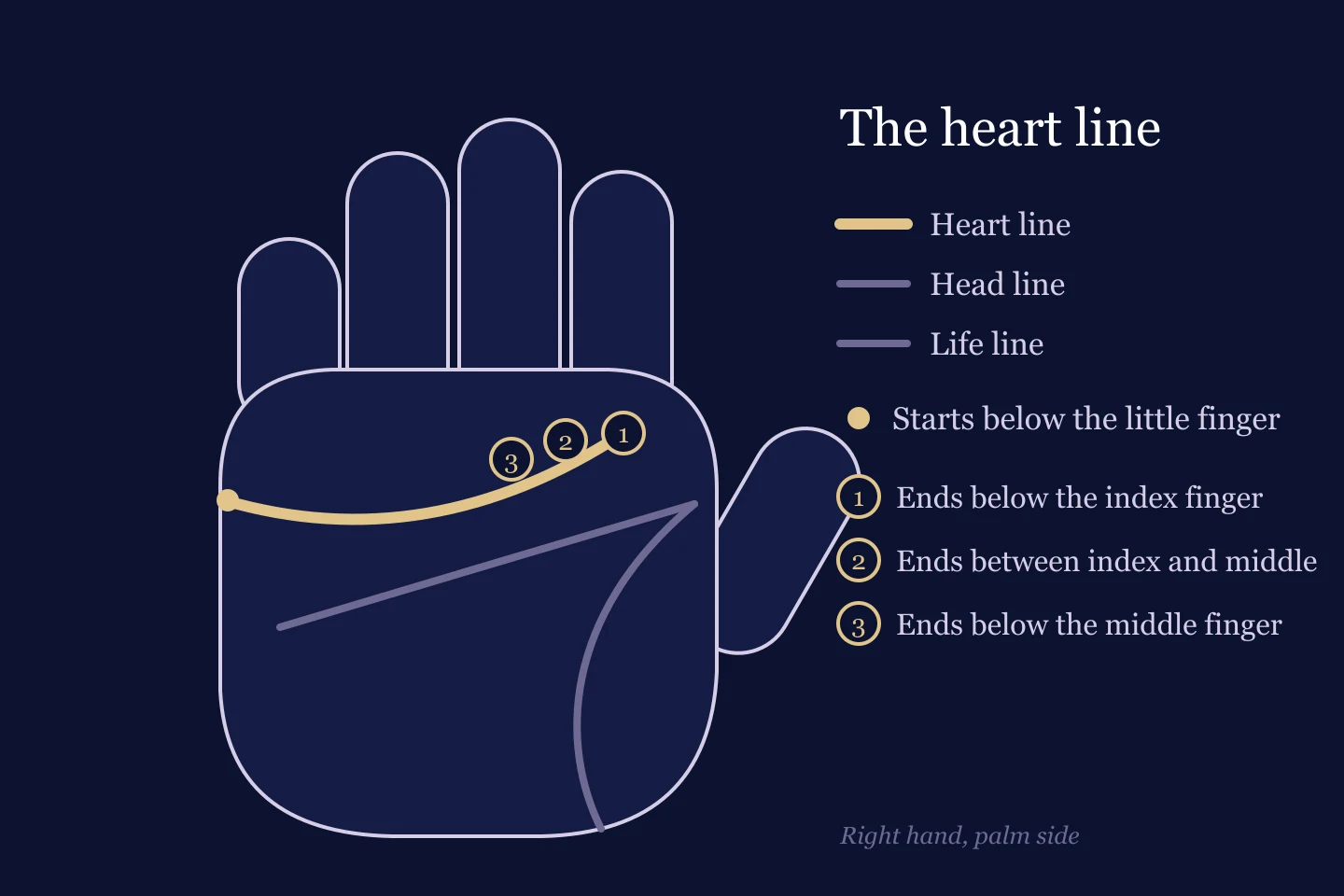
It is the highest of the three main lines that cross the palm. It starts at the edge of the hand, below the little finger, and runs towards the index and middle fingers. Below it is the head line, which crosses the palm roughly through the middle, and further down, curving around the base of the thumb, the life line.
If you find it hard to tell apart, close your hand slightly: the heart line is the crease closest to your fingers.
How to look at your hand, step by step
Find natural light from the side, so the creases show. Open your hand without straining it, fingers together but relaxed. First find where the line starts, on the edge below the little finger; then follow it with your eyes, or with the tip of a pencil without pressing, to where it ends.
Look at four things, in this order: where it ends, whether it is long or short, whether it is straight or curved, and whether it has marks: breaks, islands, chains or branches. Then do the same with the other hand and compare them.
Where it ends: three ways of loving
If it ends below the index finger, tradition says you look for a love you admire and that you set the bar high: it is hard for you to settle for less than you feel you deserve.
If it ends between the index and middle fingers, it reads as a balance between what you feel and what you think: you love intensely, but keep your feet on the ground.
If it ends below the middle finger, it is linked to someone who lives love in a more practical or self-focused way: they need their space and show affection more through actions than words.
Long or short, straight or curved
A long line, crossing almost the whole palm, is usually read as someone who gives themselves and expresses what they feel. A short one, stopping halfway, as someone more reserved, who chooses very carefully whom to let into their world.
A line curving upwards is linked to warmth and showing affection without fear; a straight one, to someone who feels a lot but says less, or says it in their own way.
None is better than another: they speak of styles, not of how much love fits in you.
Close to or far from the head line
The distance between the heart line and the head line is also read. When they are very close, it is said that feeling and reason go hand in hand in you, sometimes so much that it is hard to separate what you feel from what you think. When there is a lot of space between them, it reads as an open, generous person who lets themselves be carried along.
On some hands the two lines merge into a single one that crosses the palm from side to side. It is called the simian line, or single palmar line. Tradition reads it as a very intense way of living, where what you feel and what you think always go together.
Breaks, islands, chains and branches
A break or an island, that small oval that looks like a buttonhole, is usually read as a stage of doubt or a wound that marked you. A chained section, as a time of intense or changing emotions. Small branches rising towards the fingers are linked to bonds that brought you joy; those that drop down, to disappointments that taught you something.
A mark does not announce a breakup: it speaks of something you lived or are going through. And fine lines change over the years, so a mark you see today may not be there in a while.
Both hands tell a story
Palmistry reads both hands. It is often said that the hand you do not write with shows what you were born with, your natural way of loving, and the one you write with shows what you have done with it, what life and your choices have drawn.
When the heart line is very different on each hand, it is read as an important change in the way you love: someone who learned to open up, or to protect themselves.
The union lines, next to the heart line
On the edge of the hand, between the heart line and the base of the little finger, there are usually one or more small horizontal lines. These are the union lines. Tradition links them to the relationships that have marked you most, or will: one long, clear line, to a deep relationship; several short ones, to briefer stories.
They are not counted as an exact number of partners: they are read by how clear and long they are, and always together with the heart line, which says how you live those bonds.
What you can read yourself, and what needs a reading
With this guide you can recognise your heart line, see where it ends, whether it is long or short and whether it has marks, and start to understand how you love. What is harder to do on your own is putting it all together: the line with the whole hand, both hands with each other, and what is happening in your life right now. That is where a calm reading that looks at the whole hand and takes your question into account gives you a fuller picture.
Common mistakes when reading it
Mixing it up with the head line: the heart line is always the one closest to the fingers. Looking at one hand only. Drawing conclusions from a single mark. And above all, reading it as a verdict: the heart line speaks of how you love, not of who you will end up with or when.
Why one line does not tell everything
The heart line is read together with the mount of Venus, the fleshy base of the thumb, which speaks of passion and tenderness, and with the union lines, the small horizontal lines on the edge of the hand below the little finger. Read together they say much more than apart, which is why a full reading looks at the whole hand.
Where a ritual fits
If you want someone to read your heart line together with your mount of Venus and union lines, Asher’s love palm reading focuses on exactly that, from a photo of your hands.
Questions
Which hand do you read the heart line on?
Both. Tradition says one shows what you were born with and the other what you have done with it, so they are compared.
Can the heart line change over the years?
Yes. Fine lines change over time, which is why a reading speaks of your present moment, not of something fixed.
Does a broken heart line mean a breakup?
No. A break is read as a stage of doubt or change, not as a sign that a relationship will end.
Is a phone photo enough to read it?
Yes. With your palm open, good light and no flash, the lines show clearly.
What does a double heart line mean?
It is uncommon. Tradition reads it as a great capacity to feel and to protect the people you love, sometimes with very intense emotions.
What if I cannot find my heart line?
It is almost always there, but very fine or merged with the head line into one line that crosses the palm. Look with light from the side and with your hand slightly closed.
More guides
Content for spiritual and entertainment purposes. It does not replace medical, psychological, legal or financial advice.